Showing posts with label Painting. Show all posts

Saturday, September 5, 2015

My Life Aquatic

IMG_5925
Slightly mineral, the fresh morning air arrives cool from a slight breeze off the Shilshole Bay. After moving around and traveling so much recently, I feel I need to sit still for a while. I take a thermos of strong coffee to the Hiram M. Chittenden Locks, locally known as the “Ballard Locks,” where I plan to think and look at the water. They’re curious, the Ballard Locks. Here, Seattle’s main freshwater lakes, Lake Washington and Lake Union, mix and mingle with the salty inland sea of Puget Sound. The Ballard Locks connect the bodies. They are intricately engineered to move hulking commercial ships, tugs, and barges—as well as smaller pleasure crafts and kayaks, up and down a 26-foot elevation. But this infrastructure was also designed to prevent damage to the freshwater ecosystem and salmon. The locks are an important part of the region’s maritime history since 1916, and with more than a hundred thousand boats, over a million tons of transported cargo, and more than one million people visiting annually, the Ballard Locks are also an intricate mix and mingle of human life.
IMG_5794
I wanted space to think because I had just crossed the country once again, in a move that brought me back to the Northwest. And after the disruption of a move, the clumsy orchestration of one big truckload of life to a new one, my entire studio ultimately remains packed away in storage. I lived here years ago and was forever changed by the area’s integration of life, nature, and water in its endless forms and dramatic hydrologic cycles. Though much has changed here, I feel it all anew. At the same time there is an undercurrent of feelings and new ideas that are too inchoate to process straightaway. A rich budding often emerges during travels, especially during a proper residency where the destination is designed and well equipped to produce work. Moving is very different. These are exciting changes. They are also unsettling, and render a studio practice difficult to set in motion.
IMG_5896
This early in the morning the Ballard Locks are calm, emptied of their usual tourist buzz, but water traffic is always steady. The bells ring out urgently to the metal locking gates. “Watch your lines!” call out the Corps workers as a strange orchestration cycles through—boats and ships, lines-throwing and tying lines with the rise and fall of the water. All the while local commuters, bicyclists, and runners cross and pass. Me too. I make my way, looking down for seals and salmon near the edges and then I sit down and look at the water. After a few moments, I take out my paints. I have to think, and I need to think in colors.
IMG_5930
IMG_5921
When traveling, I invariably pack my old tins and a few small sable brushes. Watercolor is a medium I take seriously by others—Homer, Wyeth, O’Keeffe, and my mentor, Grace Hartigan. It’s undervalued a bit in contemporary art, but I like that. As a dark horse of art, watercolor handles like a private, immediate conceptualizer; capable of grabbing moments, laying out ideas in color. And though very difficult to command perfection—often it works better without—this water-soluble medium is extremely complex in its economy, without the pressure of finished work. Watercolors slow me down, bring me back to the wildness of materials at an intimate scale. It is intensely personal; at once vigorous and then startlingly tender. All, it seems, at the palm of the hand. Particularly, the medium’s uncertain expressiveness draws me into it. These are the properties embodying the idea of letting go.  Their inherently inchoate attitude allows for the necessary sprezzatura I need begin again. But especially here.
IMG_5933
I have been just watching the water, deep in reflection, when the all-encompassing sensation of shifting internal layers take hold. Water and its ecosystems, the mystery of unseen aquatic life: it is an all-encompassing maritime experience immediately stirring a series of deep chords. Submerged, there are immediate circumstances and memories. It seems appropriate that the freshwater separates and intermingles with the sea’s saltwater inner-workings right here. This is the undercurrent, I’m thinking, it moves on with or without me.
IMG_5934
I’m stirring my tins with water. I’m laying out brushes, a rag, everything that fits into a small pack along with a few books. I peer down into the water, poised. What I’m trying to do is discover something ultimately ungraspable. I attempt, and probably fail, to orchestrate space and time in an attempt to capture the elusive lyrical nature of water, of underwater, the indifferent forms of the otherness involving disparate aquatic habitats unforeseen. It takes just one small painting and I am lost in it; lost in the rushing, forever swirling flotsam that in pale yellow rose blooms continuously curl in outwardly reaches.
IMG_5879
When I sit up, I face the arched spillway that maintains the water level of the lakes. This is where young salmon pass safely downstream through smolt flumes. I regard the little painting I just made. It’s curiously satisfying—the first of many to come, mysteriously unforeseen like the under-passing aquatic life. On the opposite side of the locks there is a twenty-one step Fish Ladder. This ingenious system allows safe passage around the locks for the arduous migratory journey of spawning salmon. Adult salmon swim from the ocean to the tributary streams. They pass around the locks and continue to Lake Washington and Lake Sammamish. It seems they are always on the move. Pacific salmon hatch in freshwater rivers, streams, and lakes before migrating seaward as smolts. At the end of their life they return to fresh water to lay their eggs, and the cycle begins again.
IMG_5942
IMG_5924
IMG_5927
I understand the time it takes to throw oneself, heart and soul, back into the flow of a healthy studio practice. In coaxing a habit of work, I have returned to the unique vocabulary of watercolor: painting backwards, transparency, effusive blending, and embracing expressive coincidences. Work is a garden one needs to cultivate. It takes a concerted effort and loving commitment. It is never very easy. Otherwise, why would it be worth it?
IMG_5923
The water is complex enough; surface tension shifts, contradictory currents pulling underneath. It’s continuously changing. As I try to understand through color, shape, implied movement, it remains evasive. What’s important in understanding water is that it takes compassion for the unseen. Often its design suggests clarity. It lets you glimpse beneath the surface, but only momentarily; the water always changes its mind. And sitting, looking deep, thinking and painting, there is much more.
IMG_5935
IMG_5932
A Great Blue Heron swoops low and vigilantly against the cold rushing waters, turns from slate-gray blue to burnt umber and chestnut against the green tinge of lock water. The heron lights on the southern, Magnolia side where just the other day I stood beneath a great rookery of slightly swinging nests located high above the pathway. All day long they fly overhead. Now, thirty-feet below the Fish Ladder switchback, the heron stands quieted to the edge of dark swells. The dominance of this oddly prehistoric-looking creature in its natural hunting arena is captivating. Far above, urban foot traffic teems with bicycles, buggies, runners, and gaggles of tourists. In the close water breeze the heron’s long shaggy plumage transforms into a 1920s Flapper dress. Meanwhile, behind me, the locks fill up and let out, rise and fall, and bells urgently growl. Directly to the west are indifferent forms: the Salmon Bay Bridge, a single-leaf bascule bridge, falls from its counterweighted, upward position. A train crawls through its steel through-truss and crosses the canal, carrying a large airplane fuselage that looks like slow-moving rocketship. A seaplane passes over.
IMG_5882
The whole time I’m watching, I’m thinking: this all about the mix and mingle. Ostensibly, I’m attempting to make this small slight painting embody an actual marine ecosystem, they way it coexists with freshwater habitats, and, with us. I’m immersed in descriptive color, sudden limpidity, and the intimation of contrasting movement. I am working wetness, vastness, translucency, and the unseen spectacular natural forces. Because … perhaps there is a further level of symbolism here? Then I think, after several paintings—am I really able to coax this much of a mere watercolor?
IMG_5912
Sometimes, when I am deeply involved in the studio, painting, I really do believe it. Right now, I am so inside its careful consideration that I am comparing human conflict to the sea, and a tidal of emotion mixes with part of human nature. I believe it. I am attentive and emotive with the only visceral response I think I really understand, through the poetic language of paint. Isn’t it true that water is the most common symbol of the unconscious? It is a lucid form, a sensory theme, that constantly fluctuates between the internal and external, the personal and the public. And it becomes a liminal set between human and non-human, physically and biologically taking us to the underworld. And the extremity of coexisting ecosystems is allegorical to the frequency of human struggle. Painting water with watercolors provides a commentary on the universality of experience and value of the recognition of this tolerance. Empathizing with water by being mindful to look close is metaphysical and transformative. However, I’m an artist, not a scientist. I’m not positing how environments are held together–though I can’t tell you how often I feel I am a scientist of some sort, asking what can be obtained from intensive observation and emotive expression!
IMG_5926
IMG_5774
What begins as an intimate exploration of the actions of water and aquatic life emerges as the relentless forces of reality, both man-made and marine, through the daily practice of beginning again. What this entails is the allegory of exhaustion, the resultant and lucky unreliability of perception, and a willing embrace of continuous uncertainty. As I paint, I’m discovering something new. It’s both an intensive environmental dispatch of the mix and mingle of fresh water and the salty sea, while also an immersive interchange of nature within the trajectories of the human sphere.
IMG_5909
Once, years ago, I abashedly allowed my mentor, Ab-Ex Painter, Grace Hartigan, to have a look at some of my watercolor ideas. She scoffed at them and said, “Do what I do, Rob, take them in the shower with you.”
IMG_5892
See it here in its original form at the Michigan Quarterly Review: 
http://www.michiganquarterlyreview.com/2015/07/my-life-aquatic/

Poiesis: On Drawing

10. Swan Swan Light
I like to think of drawing in Martin Heidegger’s use of the Greek term poiesis, or the process of the thing blossoming out of itself like the opening of a flower bud—or, even more pointedly, like the melting of a frozen body of water and the ensuing rush of waterfall. Poiesis is the process by which burgeoning creativity passes a threshold and is quickly released into fruition.

Robert Sparrow Jones, "The End of Islander", Graphite on Arches Paper, 6 x 5in, 2013
Robert Sparrow Jones, “The End of Islander,” Graphite on Arches Paper, 6″ x 5″, 2013

In the studio right now there are a few unfinished canvases leaning against the wall. Through the windows, the west Michigan snow has been falling on and off for the past few days. Every time I shovel the walk, a few hours later it has filled up again, leaving only a trace of my boot prints and shovel scuff. In front of the easel, solitary, self-possessed, I am tending to the third in a series of drawings. I say “tending” because I am allowing each of them to grow without exactly understanding why or where they might take me. They are mysterious and liminal, and yet upon completion I find them as satisfying as a finished painting. Drawing is a discipline that has always been the core to my practice. In the studio, drawing is sometimes feral and filled with the thrill of uncertainty. But it is also as curative as nature itself. The process stirs the imagination and always makes me feel I have been deployed on some old-worldly scientific expedition. However transitional and fragmentary, or complete and accurate, the discipline is a universal to many different artistic outputs. In my work, drawing is inseparable to painting.
Robert Sparrow Jones, "Tommygun", Graphite on Arches Paper, 4 x 5in, 2013
Robert Sparrow Jones, “Tommygun,” Graphite on Arches Paper, 4″ x 5″, 2013
Each painting I make starts as a complete drawing on the canvas. I think of my paintings as drawings because of their continual use of line on top of the design. Conceptually, painting and drawing connect with me differently, but drawing is a parallel to the work, and not separate. Discovering drawings by artists as preliminaries to further works can be an exciting prospect like an archeological dig. Idea sketches from Louise Bourgeois, Joseph Beuys, or Wyeth; whether these are dashed off, furtive in shape and form or furious in labeling and writing (the best kind!), they feel imperative because we are able to experience the artist’s thought process. It’s especially important because we are made privy that with any work of art, from a postulation of Smithson to the emotive sketchbook of Käthe Kollwitz, it takes many errors to coax an idea into existence.
Robert Sparrow Jones, "Master's Pond", Graphite on Arches Paper, 4 x 4in, 2013
Robert Sparrow Jones, “Master’s Pond,” Graphite on Arches Paper, 4″ x 4″, 2013
It is through these intimate works that we are able to witness the simplification of an elaborate concept because the visual language of drawing is direct and primal. It’s a visual ontological process directed from the mind, the heart, and straight to the hand.  With this intimacy in mind and artists aside, some of the best drawings I have ever seen were the ones created and given to me by complete strangers in the form of directions. These are true formative works because the creator attempted to explain something with just enough visual description that in turn, something of essence is left behind. These take the form of oblique scribbles on the back of a receipt, a quickly ripped tear-shaped notebook paper containing a slopping list of directives, or a glossy sliver of magazine, blue ink in the margin, a meander of lines leading to a tiny square and a inadvertent thumbprint—each contains something pure and spontaneous. Beauty buds in the haste and the informative.  Ideation should always be this concise and rewarding. Many of those maps I have kept and found again and again.
Robert Sparrow Jones, "Hart", Graphite on Arches Paper, 6 x 9in, 2014
Robert Sparrow Jones, “Hart,” Graphite on Arches Paper, 6″ x 9″, 2014
They end up intact, as a bookmark for Flaubert, or at the bottom of my bedside table drawer under loose change and a pocket knife. As urgent as the notes are made, their meaning, for the life of me, has been all but lost. They are still so compelling that one can make a painting directly from them. My own thoughts dial around their archaic symbols and half-words, the key of which had been pantomimed on a cold snowy walk or cupped into a rolled-down car window—If you see this, you will know. You can’t miss it; the catalpa tree on the left.  There is a bend in the road, like this, like an elbow—all is completely lost. These thought details are the only remainders of brief intimacy.
Robert Sparrow Jones, "Birches", Graphite on Arches Paper, 4 x 6in, 2013
Robert Sparrow Jones, “Birches,” Graphite on Arches Paper, 4″ x 6″, 2013
My first series of drawings came out of this. Since I was a boy, I have been obsessed and placated by the experience of nature. Because I was traveling through Spain I needed to create very small, intimate works. I was thinking of strength and fragility in nature. I felt the works needed to fit in the palm of a hand, slipped into a pocket or a wallet for a few weeks, risking wear from the passage of time. At such a small scale they were also haunting. As they developed as ideas the drawings became more intricate. Later on, in my frustration with the state of nature today, to escape into something, I begin to make larger paintings from these small works as a discourse on nature’s most vicious predators, mankind. I had to work hard to not lose the vulnerability and purity of passion the smaller drawings embodied.  Before that, all the drawing I had done was surreptitiously covered up with paint, like the snow on my Michigan walk. I enjoyed that it was like a secret, that if you looked hard enough you could discover the intimacies of wild thought. A craze of charismatic concentric circles dashing off the carnation of idea, arriving obscure, sullen, recalcitrant, and foreign. This would become a simple contour of a downward-cambered rhododendron bush. Later that bush would sprout into a tree, where the ghost of the rhododendron at its foot suddenly resembled an emptying pond.
Robert Sparrow Jones, "Signal to Noise", Graphite on Arches Paper, 10.5 x 13.5in, 2014
Robert Sparrow Jones, “Signal to Noise,” Graphite on Arches Paper, 10.5″ x 13.5″, 2014
Or better, the active afterimage of a torso and leg I could not get right. Sometimes ideas can be difficult to tame. Obsessively, I reconstructed them over and over again so that movement was better captured than accurate form. All stages remain as design architecture. Stumbling awkward textures fill passages with inadvertent and useful scumble. It forms character in the work. Each painting still begins as a labor of graphite, because it is an immediate and inaccurate way of fumbling into a more sophisticated, emotional work. Tidying up isn’t necessary because subsequent layers added in the various viscosities of color material show the underneath as a trace of something true—like those once-dashed-off maps through the gracious hands of accosted strangers.  As controlled as they may appear, my most recent series of drawings are very wild to me. Sometimes drawing feels like the only lucid cerebral space. A door opens to the magic when the mind is churning out ideas and there is nothing in between—kindness, forgiveness, humility. Even though creating new work should breed some new discourse, I think we should not be encumbered with such heaviness—only perfunctory notes, as a drawing practice is less about the outside as it is internal. Poiesis in drawing is harboring concepts and letting go, allowing for the bloom of the flower to unfold and form into its fully-realized self. Because later it is about discovering harmonies and mending our connections to the world incarnate.
Robert Sparrow Jones, "Swan, Swan II (Cygnus atratus)",  Graphite on Somerset, 22.5 x 30 in, 2015
Robert Sparrow Jones, “Swan, Swan II (Cygnus atratus),” Graphite on Somerset, 22.5″ x 30″, 2015
Robert Sparrow Jones, "Archer", Graphite on Arches Paper, 6 x 9in, 2014
Robert Sparrow Jones, “Archer,” Graphite on Arches Paper, 6″ x 9″, 2014

See it here in its original form at the Michigan Quarterly Review: http://www.michiganquarterlyreview.com/2015/03/poiesis-on-drawing/

Saturday, February 21, 2015

Benjamin Duke: A River Without Banks, by Robert Sparrow Jones

1490733_788988181161500_7649174796534580244_o
Benjamin Duke’s paintings that make up “A River Without Banks,” hosted by the Paul Collins Art Gallery in Grand Rapids, MI, are as rich and layered an experience as the concepts behind the work. Whatever meaning you ascribe to the action–personal, civic, divine, or none at all–it is certain they will leave their mark. Each work is a complicated, feral environment—a portrait of a personal and universal mash-up of transcendence.
Benjamin Duke, "Crash", 75 x 94”, 2009
Benjamin Duke, “Crash”, 75 x 94”, 2009
During the artist opening, Duke stood before a crowded gallery and carried forth his mellifluous, spirited talk. A rich stew of complex material was made a little more accessible, and certainly enjoyable, via rhetorical flourishes, brilliant connections to poetry, philosophical discourse, and art theory. Sometimes, when it slipped into the candid portal of his own methodology—home life, fatherhood, teaching—Duke set up the necessary scrims as a prism for us to look through. All the while, his painted figures budded behind him, teetering from his large canvases into something new and a bit wild.
Benjamin Duke: A River Without Banks, at the Collins Gallery in Grand Rapids, Michigan
Benjamin Duke: A River Without Banks, at the GRCC Collins Art Gallery in Grand Rapids, Michigan
These are not sedentary works. Each painting burgeons with energy. People, objects, and spaces lure us inside to explore ideas concerning our current state of multiplicity. Actions and shifting grounds overlap the way human experience intersects. Invisible strings that tie us to the world cross and weave. This culmination of relationships and experiences imprint themselves on the viewer. They overwhelmingly represent a society of the intimate and casual connections that inhibit and build our own world. For Duke, this is where the abstract, the expression, and the figural shift and unite to create a vortex. This brings us from a state of internal weaving to a new ground of cataclysmic budding. In each work, the illusory complex, centered by this action, suggests the eternal present.
Benjamin Duke: A River Without Banks, at the Collins Gallery in Grand Rapids, Michigan
In, “Crash” a highway leads to a city, palatable of multiple intersections and boundless altering grounds. The highway is weighted with traffic and the vigor of a city wrought with possibilities forebodes in the distant. Before that, literally exploding into a new ground, Duke’s vortex takes the the form of a just-crashed and air-bound convertible. Ecstatic and uncaring, bodies are caught suspended, ejecting as a signifier of constant change. This conceptual architecture is uncentered and frenetic as behaviors, actions, and reactions come together full-force in a new dynamic, contributing to the particular transformative gestalt. The fictive world designed from those physical things forms the vortex that grows and surges toward us and locks us in. These are inescapable experiences, however momentary, however perpetually happening. It is as if Duke were stating that in the lived-in world we are untethered, though the ensuing chaos allows for wonder and grace.
Benjamin Duke, "The Compatibilists", 62 x 93”, 2014
Benjamin Duke, “The Compatibilists”, 62 x 93”, 2014
Although Duke’s work is intentionally rooted in a deep philosophical discourse, it is ultimately seeded in reciprocation. Here the work becomes a truth, which makes the abstract knowledge possible. Through a construct of recognizable objects and people it makes the death-defying action accurate, as in “Crash.”  But he sometimes uses terrific humor, such as in “Enter the Dragon.” Here the vortex is imbued with a teetering stack of animal, insect, and human sinew.  In the back field, behind the stack, a light, but looming architecture repeats that shape on a different ground. Duke accomplishes his humor underscored by a lack of certainty, such as in “The Combatibilists.” Here it is through the contrast of flat apparition-like shapes verses illusory space. I think Duke wants us to not experience his illusions directly, but mediated through other entities in some shared sensual space, the way his figures in “The Combatibilists” actively suggest while drinking tea. The action of disorder is a symptom of something greater, foreboding and ungraspable in its entirety.
Benjamin Duke, "Enter the Dragon", 48 x 98”, 2013
Benjamin Duke, “Enter the Dragon”, 48 x 98”, 2013
In the lexicon of Duke’s work, lies the idiosyncratic, drawing attention to and describing of, the role of the notion of a lived-experience, lived-objects, and the present moment. There is an apparent bodily engagement and primacy in which Duke’s living connections intermingle in the world. They intertwine and resonate with a reciprocating action. Imagining multi-sensory worlds, Duke offers different levels of detail, space, light, shadow, and color with both control and abandon of the medium which creates the illusion of a multi-sensory world, embodying the corporeal and sensory dimensions all at once.
Benjamin Duke, "I’m Not Your Superman"  98 x 98”, 2013
Benjamin Duke, “I’m Not Your Superman”  98 x 98”, 2013
What keeps us tethered is Duke’s perception and skills at building his worlds. However, Duke adroitly pursues abstraction and distortion without jettisoning the sensuous surfaces of objects and space. “I’m Not Your Superman” illustrates objects, figures, and space with a sense of material expression—soft, hard, cold, gritty. In visually explaining the reality of objects with textures and wear, there entails the mark of body experience. These descriptions bring specific features of that lived-experience into greater perspicuity through the distortion. This is true especially in “The Cobatibilists” where multiple perspectives and ground shifts suggest the act of seeing, and therefore consciousness. Duke’s world’s are germinating and fill up like a tableau. There is a more fundamental realm of human experience through distortion—more attuned to the actual way in which we see the world. These elements keep us looking because they feel primal. They are true and we recognize without doubt direct qualities of the physical world.
Benjamin Duke, "Nature vs Nature", 72 x 93", 2014
Benjamin Duke, “Nature vs Nature”, 72 x 93″, 2014
It’s not just about the illusory worlds where Duke finds center. The magic is perhaps something beyond. A liminal and urgent paint language necessitates the viscous strata Duke incarnates into the work as a body memory. Even from five feet the viewer can experience the illusions being created, the invisible made viable. So fresh it seems; again, always at present. So apparent that we are able to imagine the artist in the act of imagining while simultaneously constructing the moment. He is caught up, intensely intertwined in the midst of making all tangible. Duke is working these surfaces but he is also breaking the surfaces. This is where I think Duke embodies the concept with which he is trying to communicate. We are watching an imagined and physical experience rather than just seeing a perceptual illusion.
Benjamin Duke: A River Without Banks, at the Collins Gallery in Grand Rapids, Michigan
Duke intertwines lives to remind us that the multisensory experience can be a terribly beautiful and disastrous experience. His constructs are reflective illusions where spaces are about the body’s existence in the world, the body’s activity in the world. It is important that these are worlds that have been lived in so that pondering them we don’t feel external to them. He organizes and gives structure to different grounds through which he is positioning us. When these grounds intersect a vortex blossoms. The amplification denotes specific, important changes that occur in the physical process of creation where, in the exaggeration, lies deep significance.
Benjamin Duke: A River Without Banks, at the Collins Gallery in Grand Rapids, Michigan
Yet Duke’s paintings tell us one more secret. Duke is at his sharpest when his poetic and allusive language of materials and perceptions appear to prefigure what will be seen. Detailing the tacit, pre-reflective relationship between experience and the built world, Duke seems to be painting experience, as he is receiving it. The descriptive evidence points to that of awareness. For Duke, painting is close to the palpable life of things and the world around him. We experience Duke looking and studying and ultimately reveling in the wonder and mystery of the now. We feel that. We feel his now.
Benjamin Duke: A River Without Banks, at the Collins Gallery in Grand Rapids, Michigan

Friday, November 14, 2014

Six artists get chance to create in studios at the Deering Estate in Palmetto Bay (Miami Herald)


For about seven years, Mia Leonin had the idea to write a collection of poems about a little girl named Micaela growing up in a Spanish-speaking seaside town who uses her imagination to cope with a trauma.

But all this time her idea added up to miscellaneous thoughts on paper.

“It was just this raw kind of mess of language and images. I didn’t have a story,” said Leonin, a creative writing professor at the University of Miami and who writes freelance theater reviews for the Miami Herald. “I never even thought it would add up to anything.”


About a year ago Leonin earned a residency at the Deering Estate at Cutler in Palmetto Bay, part of the environmental, archeological and historical preserve’s Artist in Residence program.

What once was a “mess of language and images” became a manuscript of about 61 poems titled, The Fable of the Paddle Sack Child.

“Literally, sitting at this desk, little by little it turned into something,” said Leonin, 46, on a recent visit to her Deering Estate studio. She lives in Kendall.

The Artist in Residence at the Deering Estate is a program that gives literary artists, as well as visual and performing artists, an opportunity to use the 444-acre site to nurture their creativity. Deering created the program in 2006 as an extension of the art patronage of Charles Deering, who built the estate on Biscayne Bay at the beginning of the last century. By 1922 the Maine native had amassed an art collection appraised at $60 million and included works by El Greco and Rembrandt.

The unpaid residencies give artists a year to draw inspiration from the pastoral setting.

Artist Natalya Laskis plans to work on several 24-by 24-inch paintings for a body of work titled, Better Homes. Through the acrylic and oil paintings, Laskis will explore her idea of gender role reversal. 

“Instead of men, women are (financially) carrying the household and men are staying at home, taking care of the kids,” said Kendall resident Laskis, 34. “My work revolves around social and economic issues – on what’s happening right now.”

A short walk away from her studio, housed at the estate’s Carriage House, Robert Sparrow Jones is working on paintings inspired by growing up in rural Pennsylvania.


“When I started to walk around the Estate, I started feeling nostalgia and I thought I couldn’t be myself unless I went back to my childhood and put myself into that landscape,” said the 43-year old Wilton Manors resident.

A self-portrait in his studio depicts Jones holding deer antlers. “I don’t see any deer out here, but where I am from, they are pervasive,” he said.

Nearby, propped on an easel, is another canvas. It depicts two blond girls. One, clad in a bathing suit, is sitting on a wood folding chair and is holding a flowerpot. The other, with a skirt and a short top, is standing next to her. The colors in the piece are slightly more vibrant than in the selfportrait.

“In Florida, it is just always blooming and vibrant colors," Jones said. “In the Northeast, we sit and wait for the landscape to change and then it’s a wow factor.”

A few doors down from Jones’ studio, Lucinda Linderman’s fingers are coated with rust and oil. She is working on a mountain landscape created from old bike chains she collected from South Miami’s Mack Cycle and from dress hangers thrown away after weddings at the Estate.

“I work with reclaimed materials,” said Linderman, an environmental artist from South Miami. “I do a lot of dumpster diving so I was really happy when I realized I could professionally dumpster dive.” 

Environmental art involves reusing tossed-out materials to create a sculpture or wearable art, such as a dress Linderman made from a dark-green parachute. Linderman, 37, is part of the new Eco and Environmental Art Residency Program, which was funded by a National Endowment for the Arts matching grant the Estate received this year. During the one- to three-month residencies, up to six artists will explore environmental art under Linderman’s guidance.

“It allows artists to come in and explore in ways they may have not,” said Yantis, the exhibit specialist.


The Artist in Residence program also allows the public to see the working artists.

“This is not a private, hide-in-your-studio type of program,” said Kim Yantis, a exhibit specialist at the Estate. “They are encouraged to rather than just leave a piece of art work at the Estate, to create an activity or an action that really involves the public.”

Laskis is planning an outdoor watercolor workshop, while Jones is creating functional wood batroost sculptures. The roosts invite bats, whose numbers have recently declined due to a fungus, to feed on insects, many of which eat crops.

Linderman will continue an Eco-Art Outreach Program, in which high school students conceptualize, create and exhibit art made with reclaimed materials. In addition, she will teach workshops for Miami-Dade County teachers on how they can incorporate reclaimed materials in the classroom as well as host environmental art talks to the public.

Meanwhile, Leonin is continuing her residency for another year in hopes of finishing the two manuscripts she has been working on – and to start writing a third, which will incorporate the Estate’s environment into her poems.

“I’ve wanted to bring the Florida landscape into my work for a couple of years. Here, the naturalists will walk around with you and show you things,” said Leonin. “One of the nice things about the residency is that it allows you to be who you are. I just needed the solitude to finish these manuscripts.”

Lidia Dinkova, Miami Herald, Aug 2013

Saturday, October 17, 2009

Barcelona


In Barcelona I had a fever. The night, heated with its foreign shouts and laughter, drifted up to the narrow balcony through the tall open windows and stood eternal. I could hear a fight being broken up from the bar underneath and the scooters interminably plying by. That evening we had met up with a curator from the states. 

In El Born we shared a bottle of Grenache that turned into another and took to the meandering cobblestones. We ended up off Passeig del Born in a teeming little place with great strange paintings on the walls with a gorgeous dinner of tapas fusion. Afterwards, we walked through crowded Barrio Gotic, said our goodbye’s after which I had a nightcap at the hotel bar.


Earlier that day I felt overcome by fatigue but shrugged it off from the travel, splurged on a visit to Casa Milà, my favorite Gaudi, and absorbed the awe and wonderment. The undulating windows and the blue tiles made me feel as if I were submerged in the sea and I stood like Neptune on the terrace looking down at the boulevard from the Suess-y stacks and the tiled whaleback-like hump. 

Suddenly though, after the gentle day and that happy evening, I became achy from top to bottom. At the hotel bar I sat awfully aware something was off and I barely made it upstairs to my room. As my fever broke out I was doing my best to crawl into bed. I still had all my clothes and shivering uncontrollably.


The few weeks prior I had spent north of Barcelona in the arid rocky terrain of Montserrat. The Benedictine Monk retreat at Montserrat, some of the most spectacular mountain views of Catalunya and a certain fame for its numerous miracles associated with the intercession of the Black Virgin of Montserrat. In another ancient monastery where the monks once made wine and you could still see the stone shoots throughout the walls on the lower level, this is where my residency began and here is where I made these paintings.


The heat was sometimes unmoveable and we were valley-ed by the surrounding groves of almond trees, wild roaming boar and an old winery. You had to walk up out of the valley by a steep dirt road into a small Catalonian town for groceries, espresso or a milky Clara, a half-and-half composition of Damm cerveza mixed with sparkling lemon soda, Fanta limon, or a lemon Fante; Clara refers to the white of a raw egg, precisely the substance that a Clara resembles, at least in color. Or sometimes the end of the precipitous hike was not without a rewarding swim at the municipal pool where, unbelievably, you can gaze up from the base of Montserrat to the solid rock formations reaching up like wrinkly fingers, like drip-castles, and you can understand why Dali and Gaudi made frequent visits here. Afternoons at the pool with a Clara in hand, tipped back on a blanket in the grass and a book, this was good life.


There was another path you could take from the monastery that was mysterious. A hidden, seemingly haunted, grotto, a glassed-in Madonna and a cold running water pool cupped in front. From here the slender path up the hill was nearly vertical and the quick switchbacks, flanked by wild prickly pear and old growth yucca plant, allowed for secret offshoots of narrow terraced farming, a most interesting architecture of land and necessity. I jotted down quick ideas for further use; even my hikes were assiduous.


The first weeks in Spain, the weeks before my beginning my artistic endeavors at the monastery, I spent in a different fever. Barcelona has a darker, much seedy side. In El Raval, my strange lodging in a trendy hotel, offered a start like a shot fuse to a row of ladyfingers. Maddening yelps, it seemed, the night skies touted and gunshot and the Moroccans’ skillfully sweeping eyes.  The prostitutes I passed each day; behind my hotel they mixed along the graffiti-ed alleyway, of tiny brimming groceries, in fit-full colors and side by side to small festive clothing shops. I enjoyed being here, the grit of this neighborhood was vibrant and multi-cultural. There was an enormous amount of tapas bars and I spent my days on a rented Vespa, searching for Gaudi, collecting nuggets of visual information, drawing, painting and absorbing internally the language with passion and fervor.


The Mercat de la Boqueria in Las Rambla, a few blocks from my hotel and past the opera house, the Gran Teatre del Liceu, is where I gathered lunches and dinners. An excited contrast of vibrant color, of fresh Catalonian ingredients captured in dazzling displays, the intention of which was with such fastidious care, where vegetables and fruits and just a myriad of aquatic delight; bountiful and freshly-caught, just hours out of the sea, was a feast on extraordinary levels. Tuna and salmon, cuttle fish, the feeders from the top, feeders from the bottom, a brilliant array of barnacles, spiny shellfish—Gaudi was everywhere, and a dozens types of shrimp, mussels, octopus, oysters, lobster and the more rare species, the plenty of which I have never seen but eyed me curiously as I ebbed by.


There was also Bacalao—salt cod and then cheeses that were so difficult to decide which ones to try though each taste was a triumph. Butchery—game and eggs—whole legs of Spain’s prized hogs hung behind the counters; Jamon serrano, the famous cured ham of Spain, lean and salty, utterly delicious and ubiquitous with the most expensive, the jabugo, pato negro, costing over 200 euros per kilo. There were herbs, breads and pastries, wine—and olives! Beautifully lighted glass cases with generous white ceramic bowels brimming with olives. My favorite, the fat, green, aromatic manzanilla, but there were so many varieties, green and black, oil-cured or in vinegar, with herbs, peppercorns or stuffed with anchovy—stuffed in my memory. Oh, a dish of olives and a glass of good vino tinto! Such delightful lunches.


Also, interplayed in the market stalls were the tiny bustling open air eateries—El Quim was one such stand. On my way by one morning a stool opened up and I slid right in. Hungry and overtaken by the aromas of fresh garlic cooking, I immediately ordered the first thing I saw being passed over the counter that looked curious and delicious. It turned out to be eggs and fresh baby squid, Boquerones, truly one of the most interesting and wonderful meals I had on the street.

Against the swarming activity, the everyday ritual of locals and marketers haggling, bartering, squeezing and prodding, all played against the tourists and the so many different languages and the smells and flowers, utterly cacophonous and beautiful at the same time. Later the discovery of the much quieter Mercat del Born offered a much more relaxing atmosphere and a bit cost effective for my quickly diminishing stipend. But both markets were oases for lunch and dinner picnics and made it easier to go out a night and eat in memorable restaurants.

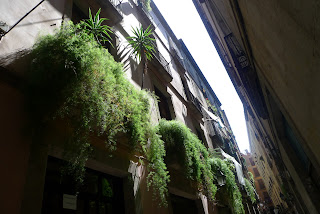
The day Michael Jackson died I was in the Barri Gotic. A bottle of wine and a dish of Paella Costa Brava at El Gran Café. Glamorous Modernisme, dripping red with velvet curtains, carved wooden details, gilded mirrors and warm globed chandeliers. Such elegance in the soaring pillars, which cantilevered a soft plinking of the piano player’s “Bewiched.” In the dining room, looking out onto narrow Carrer d'Avinyó, a bottle of red wine crashes to the floor and the evening balcony diners quickly survey the scene.

All over the city I fell in love. With the narrow streets, the enticing resteraunts, the palatable richness of life and the parks. Montjuïc, the large hill just that overlooks to the south of Barcelona, a lofty ride in a cable car from the Old Port, high up and languidly crossing the sea.
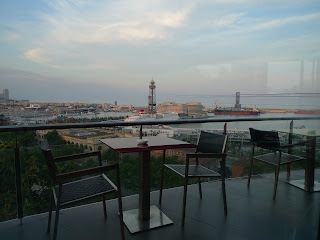
Views of bustling Mare Magnum, La Rambla del Mar, all the way to the mountain bluffs. Later it was great to drive the Vespa up there on the fast twisty roads for a glass of albariño on the National Palace, the Palace of Alfonso XIII and the Palace of Victòria Eugènia. 


Looking down on the Plaza España was a grand entrance passing between the huge Venetian towers and the Avinguda de la Reina Maria Cristina. It made an exciting ride home, zooming up the elegant Passeig de Gràcia boulevard; running from Plaza Cataluña up to Avinguda Diagonal to the centre of the Eixample district. Bountiful wide, tree-lined with iron lamps, the opulent smear of light emminating from the designer shops; Chanel, Armani, Gucci, Yves Saint Laurent, Lacoste and Cartier, glowing like insets of lavish gold, fabrics too fine for touch, draped across soft melon displays, the passing; so eloquently dressed, while I, all in a faintly oil, left a smoky wandering trail. It was the Gaudi that impressed me along these busy streets; the architectural treats of Casa Milà and Casa Batlló—an amazing adventure to just witness these beautiful masterpieces via scooter at night.  

Just outside of city center, a hilly green gently above Gràcia, Parc Güell overlooks Barcelona, situated and sequestered as if it were the city’s mind. Mid-morning and mild, a Vespa ride fueled by espresso and a pastry, a few things gathered from La Boqueria and another climb. The meander up among hidden villas; and a pact to return just to explore and live right here, to farther up where Gaudi’s visionary Parc Güell awaits in a dream. Hours were spent wandering about the paths, spying city views and the exotic plant life, the palm trees—it was here I discovered, to my amazement, the many flocks of bright squawking green parrots.

It was cool enough to sit in the melding of architecture and plant form/sea form like the terrace supported by pillars, where, from underneath, is a certain lovely underworld. Looking upward I listened to the gifted street musicians while the notes from a bass cello and a violin entwined effortlessly. You could envision them swarming to the ceiling tiles, drifting to the top promenade and surrounding the undulating mosaic bench.
  
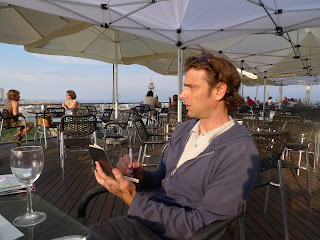
And after wandering the colonnaded paths throughout the park, there is a café where, sitting for a ponderous time, within the shade of a gather of umbrellas, I ordered an espresso, made a few sketches and finished with a glass of wine. Pure enjoyment. 

The next there was Parc de la Ciutadella, hosting an exotic array of Mediterranean ecology including one magnificent fountain, the Cascada, designed by Josep Fontseré with his assistant, the then young Gaudí, a strange and ostentatious wonder. You can spy grey herons here, the park is home to the largest colony of grey herons in Catalonia, I was told by a local. You can also use a rowing boat on the lake, though I didn’t. And there was an unusually larger-than-life mammoth elephant sculpture, tusks and all. What a green island to relax, to rebound for a while and to go for long walks, as well a picnic or two and to lie down and soak up the warm sunshine, which for me was my sketching, writing and making a few small watercolors. I thought if I would do anything at all I someday would construct such a garden. What dreams could be made here were plentiful and easy. 

After my first rush of Barcelona was an introduction to living somewhat in isolation in Montserrat at the monastery. The calm hot days, the vivacious communal dinners at ten, I began my first paintings here in an intimate format; on none other than rolling paper. I had been thinking of paper, I was sketching and painting small watercolors on the streets and gardens of Barcelona. On Arches and Cotman and Fabriano I painted with a small tin of multicolors and waterbottle. 


I was then in the mountains, in queue at the counter of the small town grocery and I spotted them, or rather, they came to my vision. Traveling for so long I rendered myself to a mindset of resourcefulness; I was inspired and ready for anything, come what may. The discovery of the rolling papers in that grocery called up my boyhood like an easy wave. How delicate I remembered the paper had been—and because I knew no translation for them—in the country no one spoke a lick of English and I, not very exceptional at Spanish let alone Catalonian, I pointed and re-pointed, made a gesture in my fingertips, of rolling out tobacco, the craft of smoke which procured the small flat folio.  

Painting on the tiny papers—they were about one and a half inches by three, seemed like the perfect thing to do. As a boy I never smoked, though my friends, who were older than I, smoked up a storm in the woods—if nothing, out of curiosity and the longing for brute growth and independence, the likes of Caulfield and James Dean, Harrison Ford in “American Graffiti” and anything Brando, or those orphaned boys in the S.E. Hinton novel, “The Outsiders,” they all easily come to mind. I loved being in the woods and went with them just for the forest. To be underneath a high canopy of deciduous trees, wading the river of fern and laurel and sit timelessly on a rock. That was natural to me, still is. And because I need to make things with my hands, while my good friends practiced a drag, directed an exhale, I carefully dismantled those cigarettes, their fine tooth in my fingertips, their briny odor stained in my palms. Those were fine memories and the rolling papers brought me straight back to the cool woods of Northeastern Pennsylvania. During the evenings in Spain I had been exploring the mountains by running tirelessly through the dusty olive groves and up to the sloping runs of Montserrat that suddenly jutted upward. The rocky roads brought old stone farms to pass, some abandoned and beautiful to explore. One seemed surely deserted but contained a lovely raised garden, a free roaming donkey and a great place to sit under an old shady date tree. I scaled a bit up those solid rock forms and wished I brought my camera for the views and every evening I trudged back to the monastery, exhausted yet revitalized with fresh memories of the cool woods sitting in the back of my head. 


After completing a few small works on rolling papers I decided I needed a scale change. I needed for them to be bigger. Tiling the small papers together for the larger works was a natural amendment to my ideas. Using the rolling paper connected with my childhood but also, in retrospect—as with most art; experimentation in different media and form brings out the subconscious, I had been most concerned with nature however the completed paintings took on the unmistakable appearance of the tiles and mosaics I had been discovering and living with; the Gaudi and the Moorish-influenced tiles. Deconstructing the painting by it’s small rectangles, working on them individually and then rebuilding the works onto the wall was a different process for me and allowed surprise. 


For a few weeks I painted in this manner until it was time to get back to the city again. And here is where I caught my vertiginous fever and thought I would disappear like an apparition, like a stream of wafting smoke. I could not help but call up the haunting imagery from the Paul Bowles novel, “The Sheltering Sky”. In my hotel room with tall ceilings I was shaking uncontrollably. It was the middle of the night. Quickly my shaking would vacillate to a fiery hot sweat. It went back and forth like this for an interminable amount of time, I hardly slept at all and read halfway through the only American novel I could find on the bookshelf in my room. 

Somewhere near dawn I think I finally did get some rest and I spent the following day walking around the city in somewhat of a daze. My recovery was oddly instantaneous—with the aid of some heavy-duty over the counter fever medicine. I took it easy in the park, making a few watercolors and headed back to the mountains. 


But I was restless back at the monastery and with country life and a decision was made to wander further north to explore the shores of Costa Blanco. Watching the city disappear into the rolling hills and small towns of Northern Spain I passed through fields of sunflowers and I kept thinking about Van Gough, his yellow house, appropriate for a trip so close to Arles in the south of France. Intense yellows and greens and blues, you could envision the defining brush strokes and direction of paint. These fields held a rushing vitality just as those Van Gogh paintings, the cypress trees, the blue skies and bucolic life. What a tumultuous and passionate fellow, created so many works and left us largely unknown, around the same age as myself…Tea in the Sahara. Passing those tremendous fields of sunflowers, all facing a single direction, I thought how intensely beautiful they were and at the same time, how beautifully violent. 


I woke up in Roses to the arc of blue Mediterranean. Brilliant and ebullient the journey began to climb up over the steep mountains of the Cap de Creus, the easternmost part of the Iberian peninsula, the Mediterranean end of the Pyrenees. Slow and steady the steep ascend rendered me wide–eyed and pressed to the windows. Sewing lines of meticulously piled stonewalls and low stacked stone dwellings—architecture that followed the landscape, disappeared into hills and prairie, melding effortlessly throughout the windswept slopes. Among cacti, scrub, sage, thorny broom and French lavender the coastal town of Roses was getting smaller and smaller. The back and forth sway was exhilarating but by the cresting switchbacks of the downward side to secreted Cadaqués I was rendered nauseous. Perhaps an appropriate foreshadow to a Dali adventure. 


I have never been to a more romantic and mysterious city in my life (second only to Naples). Like a pearl from the sea, this fishing village clings to the side of a mountain, whitewashed with breakthroughs of the Mediterranean, hidden arcades and a road that hugs the incessant laps of the evening tide. The narrow streets of climbing vine are very steep, paved with rough slate and zigzag over the mountain like a rabbit warren. They become windy alleys by night, all leading down to an array austere beaches. But first from a distance; the far rocky coast is fringed by beautiful crisp and quiet coves and then you approach Cadaqués as if you were to approach a wild animal. 


Almost completely cut off by land, this fishing village remains hidden until you get to it. Isolated by the mountains of Pani Puig, Puig Bufadors and the rest of the Emporda, a comforting sense of isolation, and yet the cafes and bars were continuously full of activity, the nightlife was bustling with small excellent restaurants, the best of which were hidden in the secreted alleyways; one of certainty was the Mermaid Restaurant, hidden on a small dead end alleyway off of Carrer des Call, a tiny street named sa Sirena (Sirena literally is mermaid in Catalan) but before you turn the corner, there laid out in tiny stones is an urnshaped mermaid leading you, if your nose doesn’t lift your attention from the path. I stayed at an old hostel near the highest point in the center of the village, just a few steps away from the 18th Century Santa Maria Church. The concierge would bring out jam and toast and espresso in the morning, plates of cheese as well and answer with a curious lengthy and dipping, “sshhee, sshhee”. During the evenings the windows in my room remained open to the cool breeze and the quiet meandering from narrow Carrer de s'Esglèsia. One evening they were singing a birthday song below in Catalan as all the shop owners gathered with slices of chocolate cake on plates and flutes of champagne and mingled in the setting light.


Mornings were comprised of a walk straight down steep Carrer des Call, a whited tall valley to the sea. Everyday it was a surprise to enter the peek-through and enter the Plaça del Doctor Trèmols where people would mill quietly in search of espresso and breakfast. Here, sitting in the evening on the stonewall or a sea-facing bench with a bottle of wine and some cheese this was the perfect place to watch the waves and the setting sun or the people, or both. Before entering the plaza, before the low archway, just on the inside of the village sits a small fruit and vegetable market and a cheese and meat shop to stock up on lunches and then out for a walk in any direction. The dramatic terrain, the narrow and stony beaches; any one of them was remarkable for an afternoon of exploration or just reading and sketching. Also in the mornings, pre exploration, off the village's main square Es Passeig, situates a frenzied pastisseria. Excellent for espresso or tea certainly, but also for the amazing array of pastries; trays and trays of mushroom-cap-shaped cakes, the base of which I was told is just sugar and butter with a little sugar on top, a sort of sponge cake, gets their lineage from the eighteenth century. An indelibly sweet snack; they baked different kinds everyday—some were “flambejat” with rum. The croissants were excellent as well and the barista always said “Mercy” to me.


Tiny and old, the weatherworn Catalonian ladies, after pointing sharply and haggling gruffly inside the little fish market, to my amazement, always made up the village hills with their fish and fresh bread in basketry. After a long day out walks home for me were nearly always a slow surrender to the serious hikes all the way up to the daunting white walls of the Santa Maria Church. When the bell rings, from underneath you can witness its pregnant shape penetrating the tower against the blue sky. The octagonal bell tower, appropriately enough, was used as a lighthouse by the local fishermen and there is an inscription, curiously on a sundial directly gracing the bell tower’s façade. It states ominously; “ If I have no sun and you have no faith, we are nothing.”


It did make me think of Hemmingway. I though of him often. “The Sun Also Rises,” has been in my mind for so long and now I was in Spain. Driving the Vespa by the Plaza de Toros Monumental, was exhilarating and yet I did not have the heart to enter. I thought of those stories mostly here because it felt to me like it was an undiscovered little city filled with romantic wonder and danger. But those bells would ring all through the village and make you remember you were someplace special. Inside the Santa Maria Church is quite a surprise. I had been there for a while until one day I noticed the door was opened and I went in. Within the dark interior, for a moment frightfully, is a most impressive Baroque and golden altarpiece. The artist Pau Costa started this masterpiece in 1727 and it was dedicated to "La mare de Deu de l'Esperanca", patron Saint of the village. The figure central to the altarpiece is a representation of a pregnant Madonna, golden with lovely thin swimming hands and her flesh painted a light rosy-porcelain, matching her quite regal expression. Set in further; both scenes are golden dioramas and concave to the repeat of the womb or perhaps it is, still a womb but more an opened egg and may perhaps be an influence on Dali’s obsession with such imagery—this scene is situated directly over the Madonna, a carved representation of the “Coronation of Mary” (The final episode in the Life of the Virgin, and follows her Assumption) complete with a half-bare Christ, God the Father and lingering Holy Spirit like an apparition in the topmost egg dome. High up and swarming in the arches, the entire golden alters’ relieves are surrounded by golden winged angels. Their child bodies are painted the same pallid fleshy glaze; it’s a wild sight and it’s been said that the local fishermen used to hang live lobsters among the angels. This might be a Dali fable but I want to believe it, like those disembodied heads floating in the gilded wood iconography. 


Cadaqués was an attractive distraction but it was time to get back to the monastery and make some paintings. However my arrival at Montserrat, the country life I left had come to, had changed radically. The quiet monastery grounds were now teeming with festival. 

The new residents, the most of which were from Norway—nice enough but truly odd to be living in Spain among so many Norwegians—mind you, these were nice and interesting people, however they were entirely friends and family of the residency owners and not there in the mode of creation whatsoever. Their holiday turned into a bit of a nightmare. The unfamiliar faces and their children mingled in the all-night-long evenings—with some really great stories and amazing traditional Catalonian guitar playing, that was the best part however I was here to paint. Our communal dinners in the courtyard literally went all through the night—every night, and the distraction was apparent. In addition to this there was also a not-aforementioned incident involving a much necessary but neglected trip to the hospital emergency room, a hot ripping ride in the lorry with the chef and a small town twenty miles out, the likes of which will not be discussed at the present time.


Vis-à-vis the decision was easy; Costa Blanco was my studio, this is where my inspiration was coming from. I packed up the studio as quickly as I could muster, and the room and the vegetation I had collected. Johnny Shaw drove the lorry, bags and all to the Barcelona Nord. But timing is everything when you travel and in Spain making connections throughout the countryside is essential but sometimes a bit ambiguous. To be stranded is an unpleasant proposition, especially when funds were getting tight as they were then. The objective was to not have to get a hotel room and spend a night somewhere by accident. That said, Johnny Shaw zipped down to Barcelona, through the impenetrable city traffic, entered a wrong way street and bumped up onto the sidewalk right at the door of the station. This was after he accosted the Policia in a municipal lot were he was tersely asked to turn around and leave.


The first time around the trip to Cost Bravo had been relatively easily. Somehow that had all vanished. Connections were tight. I embarked on a different route and consequently in Figueres (birthplace of Salvador Dali and home of the Dali museum—his father was a public notary here—and what a bit of an oppressive town) I missed my connecting bus or, actually, had gotten there right on time but the bus was filled—the last to Cadaqués. I watched as the bus pulled away from the station distraught. Spending the night here in the small dirty station was out of the question. Fortuitously, a young couple, who were also on their way to Cadaqués from Barcelona, we connected through our distress, broken English and broken Spanish and made friends as the boy called his uncle which, moments later, procured a car. The ride was extremely fast and precipitous. In the front seat I kept my eyes on the road and widening at the quickly approaching bumpers, passing cars on two lane country roads, winding up and winding down the mountains. I was in fear of getting nauseous, which I easily fell into again—even now when I think about those rides over the mountains I get slightly nauseous.


What a reprieve to be back in this little fishing village. Cadaqués was my home. It was time to settle in and make this landscape my studio. Mornings were spent walking the coast, exploring, painting and dreaming. In the evenings I ran the coastline, the bluffs and coves, through the arid mountains, the steep grades of packed dirt and cacti to further secreted coves and distant lighthouses. On one such evening I set out into the steep hills south of town determined to make the lighthouse. Which I did but what I didn’t know was that there was a beautiful inland cove, wide and deep. High in the mountains I ran the thin tightwire trail that circumnavigated the perimeter looking far down the steep sheer bluff at the blue water, the languid wooden boats and the nude bathers. 

I collected species I thought were interesting and planted them on my small balcony as I always do when I go someplace, along with the plants gathered from Montserrat. When I wasn’t busy hiking, I was selecting a different beach to camp out and make watercolors. The placid blue seas of summer, the boats and ships of all different sizes are anchored in the bay. I’m told the very deep waters of the bay of Cadaqués is Catalonia’s largest natural harbor. And looking across the coves you can witness the abrupt coast, the sheer high cliffs, tiny islands and reefs of rocks. The boats, and old and wooden, specifically the Vela Llatina or “Latin Sail,” with over 2000 years of history, is the most traditional sail in the Mediterranean sea. I had fun painting their shape and making drawings.


Round the corner from Cadaqués is Portlligat, Dalí’s long-time home. He bought this little fishermen house and moved here with his wife Gala. These days, the Dali house is a place of pilgrimage for aficionados back then it was strange and small. The bay here now is anchorage shuffled in with motorboats and yachts, a mythical and enigmatic mooring. Almost sinister, you can say, in the piercing angles of evening sun. The atmosphere of which—the surrounding cliffs, imparts to a living inexplicable landscape of Dalí. He represented this world many times in his paintings of which you would not believe really existed until you are there within it. It was exhilarating to run along the cliffs of Cap de Creus and watch, as I believe Dalí had, as the swells of the sea crashed up against them, and the flocks of gannets, and the seagulls and the shearwaters took searing dives on the battering gusts of wind. Getting lost on the peninsula felt as if I were entrapped in one of those Dali paintings. Actually it felt as if Hitchcock placed me in Spellbound, that dream montage with eyeballs, scenes designed by Dalí himself. And there the sea in all its moods, continually affecting a presence of Dalí and charging my own work in different ways, not quite suffused with a spirit of the strange, but with unmistakable affection and admiration.

I should say, my draw to Cadaqués was unexpected but serendipitous the way I found out this magical place has had a reputation for a larger art and bohemian culture. Certainly the profound influence this strange landscape exerted on Dalí’s fanciful sensibility is apparent in his paintings however Cadaqués, has been an place of inspiration to the likes of Picasso, Joan Miró, René Magritte, Max Ernst, Man Ray but even John Cage and David Hockney and, I am even told, Walt Disney spent some time here as well as Albert Einstein, who played his violin on holiday.


One terribly beautiful but windy day I was having espresso at a café, called Meliton. The local wind, the tramuntana, howls down off the snow-clad summits of the Pyrenees and goads the Mediterranean into a raging ocean. Some evenings the sudden wind would toss the old wooden fishing boats and bring waves crashing up the ramparts. That afternoon in the hot sun the wind was so strong it blew my espresso cup, saucer and all, right off the table and all over my shirt and shorts in an explosion. I had my hoodie in my satchel and so I made into the bathroom to rinse out my shirt. It was here in queue where I was confronted with Marcel Duchamp. On the wall I noticed a half dozen curious photographs collage-ing the wall, salon-style. Apparently the Meliton was Marcel Duchamp’s chess playing café. In addition to some excellent black and white photographs there are some great ephemera, some in Duchamp’s own hand. I mention these artists and thinkers because. And next to beach, Llane Gran is a house where the Dali family spent the summers when he was a child—the house belonged to Salvador's sister till recently. But apparently this is the house where Dali spent some days with the poet his good friend Federico Garcia Lorca, one of my favorite poets and also the film director Luis Buñuel, a director I have thought a lot about. Together, the three of them wrote the “Un Chien Andalou” script here. Slicing up eyeballs—remember that Pixies song? Never mind Debaser, remember the film imagery? A surrealist masterpiece. And there is other curious evidence; outside the church there was always a white 1968 Land Rover, owned by the Dali’s own photographer who had a great curious studio across from the hostel. A sort of cabinet of wonder in black and white images and collections of Leica’s, and Nikons and Olympus’.


The last days in Cadaqués were peacefully brilliant and I went on many runs, exploring as many views as I could find. Each bottle of wine that was finished on the beach in the evenings was thoughtfully absorbed with a piece of nice cheese and some olives and amazing local sea salt and almonds. Days melded into night and into morning, right into departure early in August as the town began filling up with people. The Cadaqués International Festival of Music was beginning and every year the festival brings many talented Musicians to this remote fishing village—some of the best classical artists in the world, I was told by a Norwegian Visual Poet. Musicians to the likes of: Andre Watts, Ivo Pogolerich, Maria Joao Pire, Sviatoslav Richter, Montserrat Caballe, Josep Carreras, Victoria dels Angels as well as the Berlin Philharmonic Orchestra, the Stuttgart Orchestra and the Franz Lizt Orchestra of Budapest. Tents were rising to the palms while the on coming traffic from Roses and stretching way over the mountains was stifling bumper to bumper. The last two days in Spain were spent in Barcelona in an old hostel situated in El Born with a wrought-iron balcony overlooking my favorite, Parc de la Ciutadella. The busy traffic below, the foreign murmur and the sweet sunsets reaching over the park—my stipend had vanished and I was dreaming, promising, I would find my way back to Barcelona.